 Greis J. Kim Reyes
SUNY New Paltz
Undergraduate Research in Physics — Fall 2025
This page collects the undergraduate research projects completed during Fall 2025 at SUNY New Paltz.
Calibrating Tight Binding for Biaxially Strained Graphene
Jillian Iqbal
Department of Physics and Astronomy, SUNY New Paltz
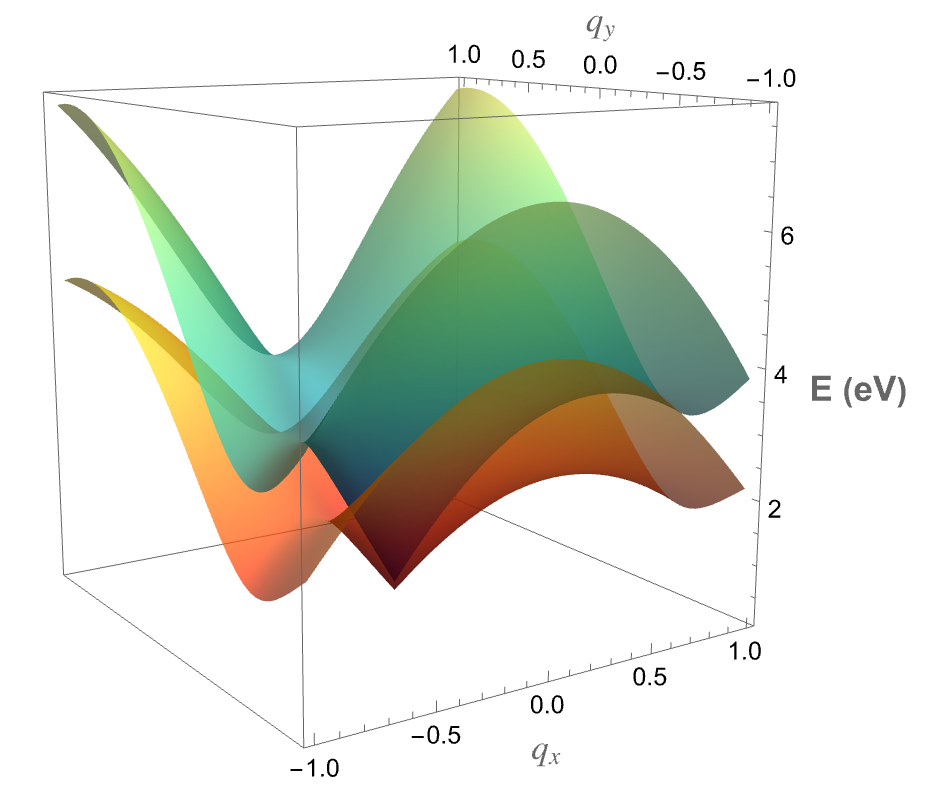
We study the effect of uniform biaxial strain on monolayer graphene using a minimal tight-binding model with nearest- and next-nearest-neighbor hopping. A constant-hopping parametrization fails to match experimental trends, so we introduce a distance-dependent hopping of exponential form, which improves the strain dependence of low-energy observables over a realistic strain range.
Heatmaps of NNN-Driven Asymmetry in Graphene
Flavio Loja
Department of Chemistry, SUNY New Paltz
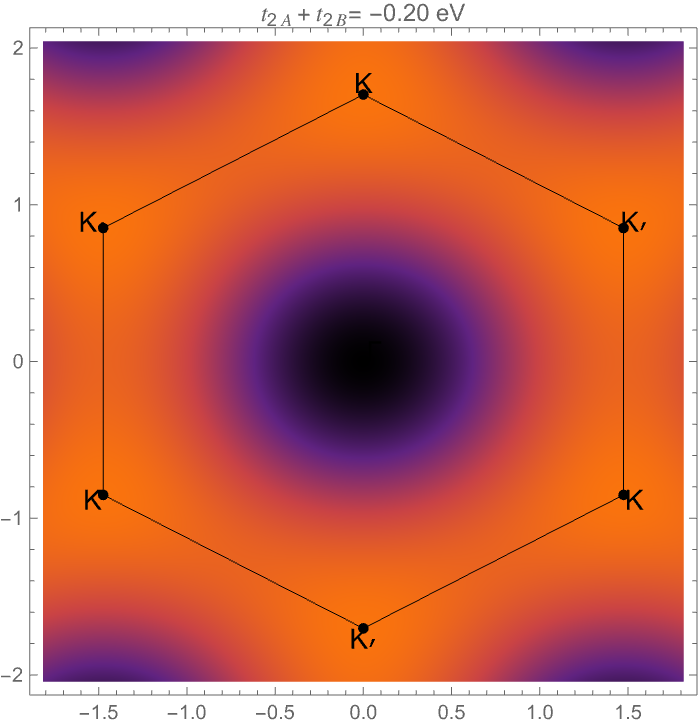
We study electron–hole asymmetry in monolayer graphene using a minimal tight-binding model that extends nearest-neighbor hopping with a next-nearest-neighbor term. Nearest-neighbor hopping alone gives particle–hole symmetry and a Dirac crossing at charge neutrality, while the next-nearest-neighbor term keeps the crossing gapless but shifts the neutrality point and skews the band curvatures across the Brillouin zone. We demonstrate this using band overlays along Γ–K–M–Γ and an asymmetry map defined by Ec(k)+Ev(k), which reveals a six-fold pattern set by the lattice geometry.
Particle–Hole Asymmetry and Barrier Uniformity in h-BN Explained by NNN Tight Binding
Michael Buccino and Kendra Scheele
Department of Physics and Astronomy, SUNY New Paltz
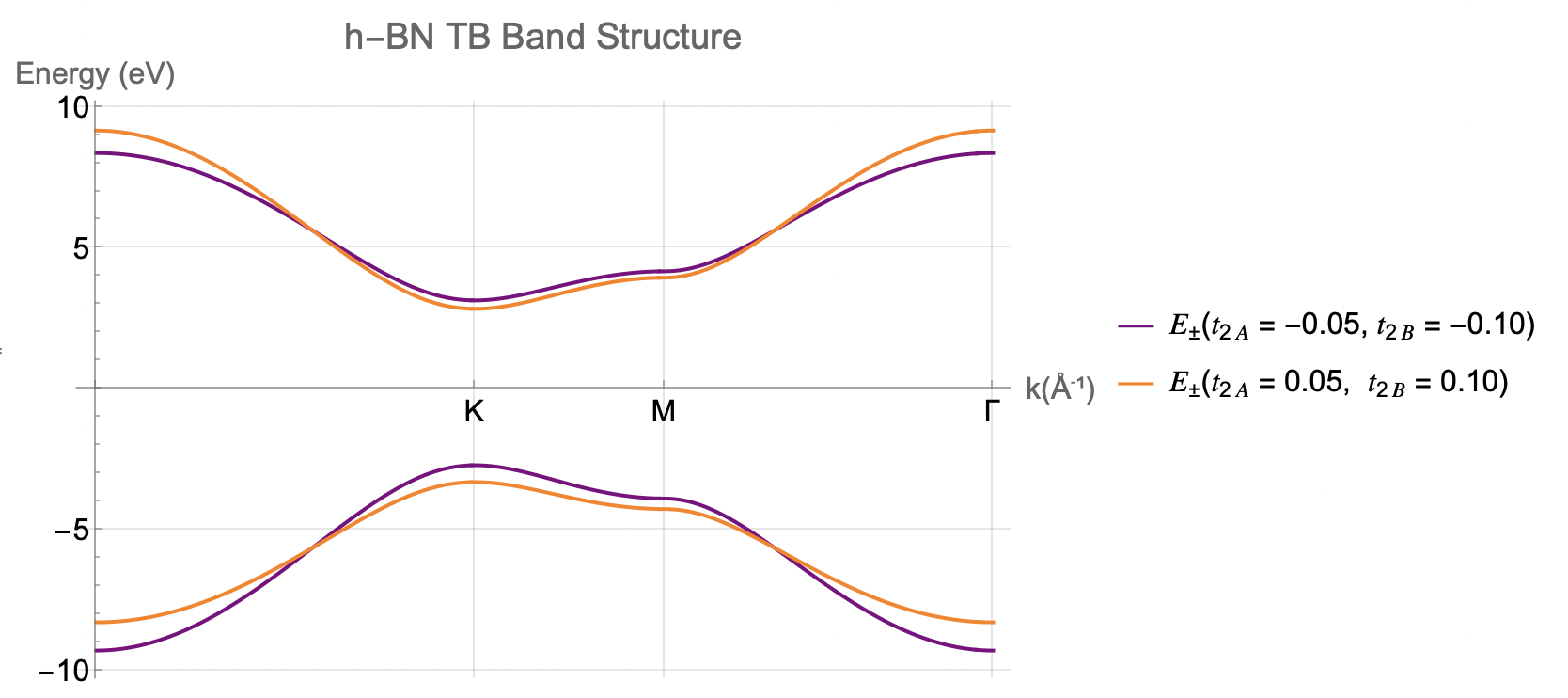
Hexagonal boron nitride (h-BN) is atomically flat, chemically inert, and has a wide band gap of about 6 electron volts, which suppresses interface traps and yields low, reproducible leakage even at nanometer thickness. We connect these device-level advantages to a compact tight-binding description of the π bands using nearest-neighbor hopping plus a single next-nearest-neighbor term. This minimal model captures particle–hole asymmetry and realistic band curvature away from K. Using the evanescent solutions of the two-band dispersion in a tunneling picture, we explain why monolayer h-BN provides stable, low-leakage insulation in two-dimensional heterostructures.