 Greis J. Kim Reyes
SUNY New Paltz
Undergraduate Research in Physics — Summer 2026
This page highlights the Summer 2026 AC2 undergraduate research project at SUNY New Paltz.
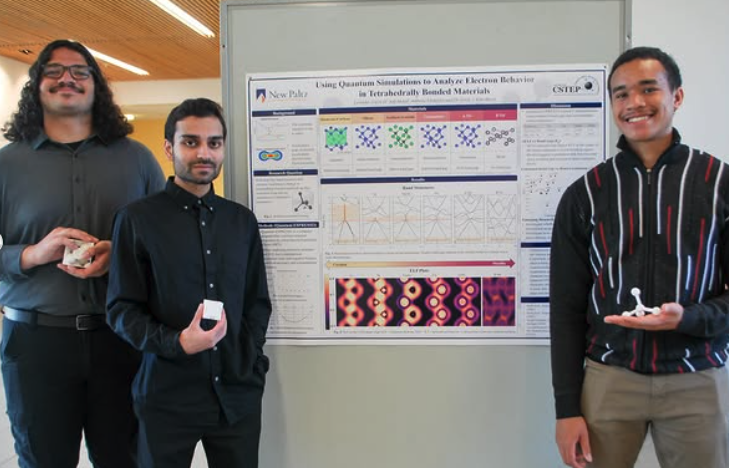
Using Quantum Simulations to Analyze Electron Behavior in Tetrahedrally Bonded Materials
Leonides Lopez IV, Saif Imdad, and Anthony Flemister
Department of Physics and Astronomy, SUNY New Paltz
This project uses density functional theory calculations in Quantum ESPRESSO to compare electronic structure and electron localization across tetrahedrally bonded materials ranging from insulating and semiconducting systems to semimetallic and metallic cases. Band structures provide the reciprocal-space view, while the Electron Localization Function (ELF) provides a complementary real-space picture of bonding and localization.
The students examined diamond, silicon, gallium arsenide, germanium, α-tin, and β-tin, and extended the comparison across Group IV, III–V, and II–VI materials. Their analysis suggests a qualitative connection between bond localization and electronic behavior, while also showing family-dependent clustering rather than a single universal relationship between ΔELF and the calculated DFT band gap.
Project highlights
- Compared band structures in reciprocal space with ELF maps in real space.
- Studied the progression from covalent insulating/semiconducting behavior toward semimetallic and metallic behavior.
- Used Quantum ESPRESSO and DFT with converged computational parameters.
- Examined ΔELF as a measure of bond-localization contrast.
- Extended the comparison to Group IV, III–V, and II–VI tetrahedrally bonded materials.
- Identified family-dependent clustering rather than a universal ΔELF–band-gap trend.
Emerging research questions
- How does ELF relate to mechanical properties such as brittleness?
- How can bond ionicity be incorporated to better understand the relationship between ΔELF and band gap?